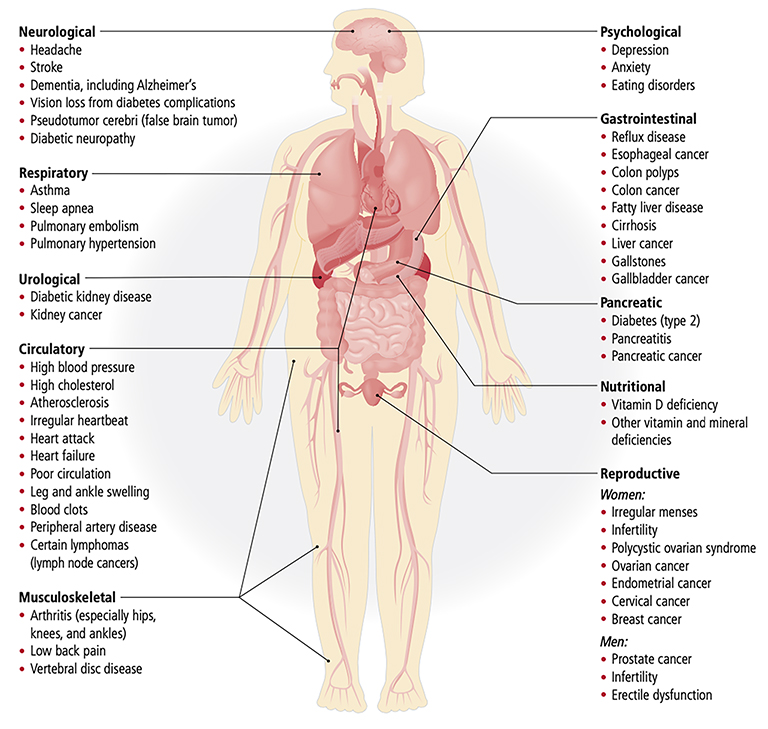
Excess pounds do more than increase your weight—they increase your risk of major health problems. People who are overweight or obese are more likely to have heart disease, strokes, diabetes, cancer, and depression. Fortunately, losing weight can reduce your risk of developing some of these problems.
Weight and your health
If you're carrying a lot of excess weight, you're at a higher-than-average risk of 50 various health problems. Heart disease, stroke, diabetes, and some malignancies, as well as less frequent disorders like gout and gallstones, are among the major causes of mortality in the United States. Perhaps even more persuasive is the significant association between excess weight and depression, because this common mood condition can have a severe, negative influence on your everyday life.
A Harvard research that pooled data from over 50,000 men (participants in the Health Professionals Follow-up research) and over 120,000 women (participants in the Nurses' Health Study) found some grim weight and health figures.
The participants supplied information about their diets, health practises, and medical histories, as well as their height and weight. The volunteers were followed by researchers for more than ten years. They tracked the frequency of diseases and related them to each subject's body mass index (BMI)—a calculation of an individual's relative body fat based on height and weight.
Obesity raised the risk of diabetes by 20 times and elevated the chance of getting high blood pressure, heart disease, stroke, and gallstones significantly. There was a clear association between BMI and risk among persons who were overweight or obese: the higher the BMI, the greater the incidence of illness.
Excess Weight Causes Many Health Problems
Weight and depression
Do individuals acquire weight because they are depressed, or do they gain weight because they are depressed? A study of 15 research discovered evidence that both hypotheses are most likely correct. Obese persons had a 55% greater chance of getting depression over time than those of normal weight, according to a research published in the Archives of General Psychiatry in 2010. The following are some of the reasons why obesity may raise the risk of depression:
Both diseases appear to derive (at least in part) from abnormalities in brain chemistry and function in reaction to stress.
Psychological factors are another possibility. Thin means attractive in our culture, and being overweight can reduce self-esteem, which is a proven cause for depression.
Odd eating patterns and eating disorders, as well as the physical discomfort of obesity, have all been linked to sadness.
The study also discovered that depressed people are 58% more likely to become obese. Here are some of the reasons why depression may result in obesity:
According to one idea, elevated amounts of the stress hormone cortisol (common in persons with depression) may modify components in fat cells, making fat storage, particularly in the belly, more likely.
People who are sad are typically too down to eat appropriately or exercise consistently, making them more prone to weight gain.
Some antidepressant drugs promote weight gain.
Sleep apnea: Why snoring is dangerous
If you snore loudly and stop breathing many times during the night, waking up with a snort or choke, you may have sleep apnea, a common disease that is more frequent in those who are overweight or obese.
Your bedmate is more likely to notice these signs than you are. Because people with sleep apnea do not become completely cognizant, they are unaware that they have been awakened, yet these awakenings can interrupt sleep. Not only does sleep apnea typically contribute to daytime tiredness, it also raises the risk of high blood pressure, heart attack, and stroke.
Weight, heart disease, and stroke
High blood pressure and abnormal levels of cholesterol and other lipids in the blood are two of the most prevalent disorders noticed in persons who are overweight. Both can result in concomitant health issues, particularly heart disease and stroke.
Obese persons have approximately six times the rate of high blood pressure as thin people. According to the American Heart Association, gaining 22 pounds increases systolic blood pressure (the first number in a reading) by an average of 3 mm Hg and diastolic blood pressure (the second number) by an average of 2.3 mm Hg, resulting in a 24% increase in stroke risk.
A 2007 research published in the Archives of Internal Medicine explored the link between obesity and heart disease by combining data from 21 distinct studies involving over 300,000 patients. The study discovered:
Obesity increased the risk of heart disease by 32%. Obesity boosted the risk by 81%.
Although the negative effects of obesity on blood pressure and cholesterol levels may explain for 45% of the increased risk of heart disease, the scientists found that even little quantities of extra weight might raise the likelihood of heart disease irrespective of these well-known dangers.
Overweight persons have a 22% increased risk of stroke than people of normal weight. Obese adults have a 64% greater risk, according to a 2010 study published in the journal Stroke that aggregated data from 25 research involving over two million participants.
Weight and diabetes
Because obesity and overweight are so closely related to diabetes, doctors devised the word "diabesity" to characterise the problem. Approximately 90% of patients with type 2 diabetes (the most prevalent variant) are overweight or obese. Diabetes incidence increased by about 65% between 1996 and 2006.
One of the characteristics of metabolic syndrome is elevated blood sugar levels, which are a hallmark of diabetes. Diabetes, if left untreated or inadequately managed, can cause a variety of serious health issues, including renal failure, blindness, and foot or limb amputations. Diabetes is the sixth largest cause of mortality in the United States today.
Do you suffer from metabolic syndrome?
Metabolic syndrome, a cluster of disorders that occur together, also raises the risk of heart disease, stroke, and diabetes. One of the distinguishing characteristics is abdominal obesity. If you have that issue, you are more likely to have the other traits.
You have metabolic syndrome if you have three or more of the following five characteristics:
Large waist. A waist circumference of more than 35 inches for women and 40 inches for males.
Triglyceride levels are high. A fasting triglyceride level of 150 milligrammes per deciliter (mg/dL) or greater.
Low HDL levels. A HDL ("good") cholesterol level of less than 40 mg/dL in men and 50 mg/dL in women. Blood pressure that is too high. A systolic blood pressure measurement of 130 mm Hg or higher, or a diastolic blood pressure value of 85 mm Hg or higher. High blood sugar levels. A blood sugar level of 100 mg/dL or greater after fasting.
Weight and cancer
According to some scientists, obesity is the second largest cause of cancer mortality, behind cigarette smoking.
The American Cancer Society studied over 900,000 participants over 16 years in a research published in The New England Journal of Medicine. The study discovered a relationship between increased body weight and a variety of malignancies. Among the findings:
Overweight and obesity may contribute for 14% of all cancer deaths in males and 20% of all cancer deaths in women aged 50 and up. Increased BMIs were connected with an increased chance of dying from cancer of the oesophagus, colon and rectum, liver, gallbladder, pancreas, or kidney in both men and women. Excess weight in males raised their chances of dying from stomach or prostate cancer. Women with higher BMIs had a greater risk of dying from cancer of the breast, uterus, cervix, or ovary.
A review paper published in The Lancet in 2008 found similar results. One source of the problem might be that persons who are extremely overweight are less likely to receive cancer screening tests such as Pap smears and mammograms.
According to a study published in The International Journal of Obesity, the bigger the woman, the more likely she was to put off undergoing a pelvic exam, owing to unpleasant encounters with doctors and their office personnel. If men are extremely overweight, screening examinations such as prostate exams may be physically difficult, especially if they tend to retain fat in their hips, buttocks, or thighs.
Weight and lifespan
Being overweight or obese can make getting about difficult. individuals carrying additional pounds have a tougher time walking a quarter-mile, lifting 10 pounds, and rising from an armless chair than individuals at a healthy weight. Experts think that the burden of these issues looks to be bigger than in previous years, most likely because people are now fat for a greater proportion of their lifetimes.
Overweight and obesity can shorten your life by years since extra weight contributes to so many common and severe diseases. A New England Journal of Medicine research that tracked more than 500,000 50- to 71-year-olds for a decade discovered a 20% to 40% rise in death rates among persons who were overweight in midlife. Obese persons died at a rate that was two to three times higher.
.
A 2010 study published in the same journal that pooled data from 19 studies that followed nearly 1.5 million white adults aged 19 to 84 for a similar period of time discovered that the risk of death increased with body size, ranging from 44% higher for those who were mildly obese to 250% higher for those with a BMI of 40 to 50.
Lose weight, feel better
Losing extra weight may improve your physical and mental well-being, as well as help you live a longer, healthier life. It's especially reassuring to know that you don't have to drop a lot of weight to get healthy. Even a little weight loss of 5% to 10% of your starting weight can have a major impact on your health. Here are several examples:
People with high blood pressure who dropped 10 pounds over six months had 2.8 mm Hg lower systolic blood pressure and 2.5 mm Hg lower diastolic blood pressure. These blood pressure decreases were equal to those caused by therapy with several blood pressure medicines.
Weight reduction is so successful that many persons with high blood pressure may discontinue taking blood pressure medication after losing weight, as long as they can keep it off. In a study of persons at risk for type 2 diabetes, those who dropped 7% of their weight and exercised for 30 minutes a day reduced their risk of diabetes by nearly 60%.
Effects on Mental Health:
Excess weight has an influence that extends beyond the physical realm and can have a substantial impact on mental well-being. Obese people may have low self-esteem, body image difficulties, sadness, and anxiety. Obesity stigma in society can lead to social isolation and discrimination, increasing mental health issues. To improve holistic well-being, it is critical to address both the physical and mental elements of obesity.
This Privacy Policy describes Our policies and procedures on the collection, use and disclosure of Your information when You use the Service and tells You about Your privacy rights and how the law protects You.
We use Your Personal data to provide and improve the Service. By using the Service, You agree to the collection and use of information in accordance with this Privacy Policy. This Privacy Policy has been created with the help of the Free Privacy Policy Generator.
Interpretation and Definitions
Interpretation
The words of which the initial letter is capitalized have meanings defined under the following conditions. The following definitions shall have the same meaning regardless of whether they appear in singular or in plural.
Definitions
For the purposes of this Privacy Policy:
Account means a unique account created for You to access our Service or parts of our Service.
Affiliate means an entity that controls, is controlled by or is under common control with a party, where "control" means ownership of 50% or more of the shares, equity interest or other securities entitled to vote for election of directors or other managing authority.
Company (referred to as either "the Company", "We", "Us" or "Our" in this Agreement) refers to Almuniben.
Cookies are small files that are placed on Your computer, mobile device or any other device by a website, containing the details of Your browsing history on that website among its many uses.
Country refers to: Pakistan
Device means any device that can access the Service such as a computer, a cellphone or a digital tablet.
Personal Data is any information that relates to an identified or identifiable individual.
Service refers to the Website.
Service Provider means any natural or legal person who processes the data on behalf of the Company. It refers to third-party companies or individuals employed by the Company to facilitate the Service, to provide the Service on behalf of the Company, to perform services related to the Service or to assist the Company in analyzing how the Service is used.
Third-party Social Media Service refers to any website or any social network website through which a User can log in or create an account to use the Service.
Usage Data refers to data collected automatically, either generated by the use of the Service or from the Service infrastructure itself (for example, the duration of a page visit).
You means the individual accessing or using the Service, or the company, or other legal entity on behalf of which such individual is accessing or using the Service, as applicable.
Collecting and Using Your Personal Data
Types of Data Collected
Personal Data
While using Our Service, We may ask You to provide Us with certain personally identifiable information that can be used to contact or identify You. Personally identifiable information may include, but is not limited to:
Email address
First name and last name
Phone number
Address, State, Province, ZIP/Postal code, City
Usage Data
Usage Data
Usage Data is collected automatically when using the Service.
Usage Data may include information such as Your Device's Internet Protocol address (e.g. IP address), browser type, browser version, the pages of our Service that You visit, the time and date of Your visit, the time spent on those pages, unique device identifiers and other diagnostic data.
When You access the Service by or through a mobile device, We may collect certain information automatically, including, but not limited to, the type of mobile device You use, Your mobile device unique ID, the IP address of Your mobile device, Your mobile operating system, the type of mobile Internet browser You use, unique device identifiers and other diagnostic data.
We may also collect information that Your browser sends whenever You visit our Service or when You access the Service by or through a mobile device.
Information from Third-Party Social Media Services
The Company allows You to create an account and log in to use the Service through the following Third-party Social Media Services:
Google
Facebook
Instagram
Twitter
LinkedIn
If You decide to register through or otherwise grant us access to a Third-Party Social Media Service, We may collect Personal data that is already associated with Your Third-Party Social Media Service's account, such as Your name, Your email address, Your activities or Your contact list associated with that account.
You may also have the option of sharing additional information with the Company through Your Third-Party Social Media Service's account. If You choose to provide such information and Personal Data, during registration or otherwise, You are giving the Company permission to use, share, and store it in a manner consistent with this Privacy Policy.
Tracking Technologies and Cookies
We use Cookies and similar tracking technologies to track the activity on Our Service and store certain information. Tracking technologies used are beacons, tags, and scripts to collect and track information and to improve and analyze Our Service. The technologies We use may include:
Cookies or Browser Cookies. A cookie is a small file placed on Your Device. You can instruct Your browser to refuse all Cookies or to indicate when a Cookie is being sent. However, if You do not accept Cookies, You may not be able to use some parts of our Service. Unless you have adjusted Your browser setting so that it will refuse Cookies, our Service may use Cookies.
Web Beacons. Certain sections of our Service and our emails may contain small electronic files known as web beacons (also referred to as clear gifs, pixel tags, and single-pixel gifs) that permit the Company, for example, to count users who have visited those pages or opened an email and for other related website statistics (for example, recording the popularity of a certain section and verifying system and server integrity).
Cookies can be "Persistent" or "Session" Cookies. Persistent Cookies remain on Your personal computer or mobile device when You go offline, while Session Cookies are deleted as soon as You close Your web browser. Learn more about cookies on the Free Privacy Policy website article.
We use both Session and Persistent Cookies for the purposes set out below:
Necessary / Essential Cookies
Type: Session Cookies
Administered by: Us
Purpose: These Cookies are essential to provide You with services available through the Website and to enable You to use some of its features. They help to authenticate users and prevent fraudulent use of user accounts. Without these Cookies, the services that You have asked for cannot be provided, and We only use these Cookies to provide You with those services.
Cookies Policy / Notice Acceptance Cookies
Type: Persistent Cookies
Administered by: Us
Purpose: These Cookies identify if users have accepted the use of cookies on the Website.
Functionality Cookies
Type: Persistent Cookies
Administered by: Us
Purpose: These Cookies allow us to remember choices You make when You use the Website, such as remembering your login details or language preference. The purpose of these Cookies is to provide You with a more personal experience and to avoid You having to re-enter your preferences every time You use the Website.
For more information about the cookies we use and your choices regarding cookies, please visit our Cookies Policy or the Cookies section of our Privacy Policy.
Use of Your Personal Data
The Company may use Personal Data for the following purposes:
To provide and maintain our Service, including to monitor the usage of our Service.
To manage Your Account: to manage Your registration as a user of the Service. The Personal Data You provide can give You access to different functionalities of the Service that are available to You as a registered user.
For the performance of a contract: the development, compliance and undertaking of the purchase contract for the products, items or services You have purchased or of any other contract with Us through the Service.
To contact You: To contact You by email, telephone calls, SMS, or other equivalent forms of electronic communication, such as a mobile application's push notifications regarding updates or informative communications related to the functionalities, products or contracted services, including the security updates, when necessary or reasonable for their implementation.
To provide You with news, special offers and general information about other goods, services and events which we offer that are similar to those that you have already purchased or enquired about unless You have opted not to receive such information.
To manage Your requests: To attend and manage Your requests to Us.
For business transfers: We may use Your information to evaluate or conduct a merger, divestiture, restructuring, reorganization, dissolution, or other sale or transfer of some or all of Our assets, whether as a going concern or as part of bankruptcy, liquidation, or similar proceeding, in which Personal Data held by Us about our Service users is among the assets transferred.
For other purposes: We may use Your information for other purposes, such as data analysis, identifying usage trends, determining the effectiveness of our promotional campaigns and to evaluate and improve our Service, products, services, marketing and your experience.
We may share Your personal information in the following situations:
With Service Providers: We may share Your personal information with Service Providers to monitor and analyze the use of our Service, to contact You.
For business transfers: We may share or transfer Your personal information in connection with, or during negotiations of, any merger, sale of Company assets, financing, or acquisition of all or a portion of Our business to another company.
With Affiliates: We may share Your information with Our affiliates, in which case we will require those affiliates to honor this Privacy Policy. Affiliates include Our parent company and any other subsidiaries, joint venture partners or other companies that We control or that are under common control with Us.
With business partners: We may share Your information with Our business partners to offer You certain products, services or promotions.
With other users: when You share personal information or otherwise interact in the public areas with other users, such information may be viewed by all users and may be publicly distributed outside. If You interact with other users or register through a Third-Party Social Media Service, Your contacts on the Third-Party Social Media Service may see Your name, profile, pictures and description of Your activity. Similarly, other users will be able to view descriptions of Your activity, communicate with You and view Your profile.
With Your consent: We may disclose Your personal information for any other purpose with Your consent.
Retention of Your Personal Data
The Company will retain Your Personal Data only for as long as is necessary for the purposes set out in this Privacy Policy. We will retain and use Your Personal Data to the extent necessary to comply with our legal obligations (for example, if we are required to retain your data to comply with applicable laws), resolve disputes, and enforce our legal agreements and policies.
The Company will also retain Usage Data for internal analysis purposes. Usage Data is generally retained for a shorter period of time, except when this data is used to strengthen the security or to improve the functionality of Our Service, or We are legally obligated to retain this data for longer time periods.
Transfer of Your Personal Data
Your information, including Personal Data, is processed at the Company's operating offices and in any other places where the parties involved in the processing are located. It means that this information may be transferred to — and maintained on — computers located outside of Your state, province, country or other governmental jurisdiction where the data protection laws may differ than those from Your jurisdiction.
Your consent to this Privacy Policy followed by Your submission of such information represents Your agreement to that transfer.
The Company will take all steps reasonably necessary to ensure that Your data is treated securely and in accordance with this Privacy Policy and no transfer of Your Personal Data will take place to an organization or a country unless there are adequate controls in place including the security of Your data and other personal information.
Delete Your Personal Data
You have the right to delete or request that We assist in deleting the Personal Data that We have collected about You.
Our Service may give You the ability to delete certain information about You from within the Service.
You may update, amend, or delete Your information at any time by signing in to Your Account, if you have one, and visiting the account settings section that allows you to manage Your personal information. You may also contact Us to request access to, correct, or delete any personal information that You have provided to Us.
Please note, however, that We may need to retain certain information when we have a legal obligation or lawful basis to do so.
Disclosure of Your Personal Data
Business Transactions
If the Company is involved in a merger, acquisition or asset sale, Your Personal Data may be transferred. We will provide notice before Your Personal Data is transferred and becomes subject to a different Privacy Policy.
Law enforcement
Under certain circumstances, the Company may be required to disclose Your Personal Data if required to do so by law or in response to valid requests by public authorities (e.g. a court or a government agency).
Other legal requirements
The Company may disclose Your Personal Data in the good faith belief that such action is necessary to:
Comply with a legal obligation
Protect and defend the rights or property of the Company
Prevent or investigate possible wrongdoing in connection with the Service
Protect the personal safety of Users of the Service or the public
Protect against legal liability
Security of Your Personal Data
The security of Your Personal Data is important to Us, but remember that no method of transmission over the Internet, or method of electronic storage is 100% secure. While We strive to use commercially acceptable means to protect Your Personal Data, We cannot guarantee its absolute security.
Detailed Information on the Processing of Your Personal Data
The Service Providers We use may have access to Your Personal Data. These third-party vendors collect, store, use, process and transfer information about Your activity on Our Service in accordance with their Privacy Policies.
Usage, Performance and Miscellaneous
We may use third-party Service Providers to maintain and improve our Service.
Google Places
Google Places is a service that returns information about places using HTTP requests. It is operated by Google
Google Places service may collect information from You and from Your Device for security purposes.
Our Service does not address anyone under the age of 13. We do not knowingly collect personally identifiable information from anyone under the age of 13. If You are a parent or guardian and You are aware that Your child has provided Us with Personal Data, please contact Us. If We become aware that We have collected Personal Data from anyone under the age of 13 without verification of parental consent, We take steps to remove that information from Our servers.
If We need to rely on consent as a legal basis for processing Your information and Your country requires consent from a parent, We may require Your parent's consent before We collect and use that information.
Links to Other Websites
Our Service may contain links to other websites that are not operated by Us. If You click on a third party link, You will be directed to that third party's site. We strongly advise You to review the Privacy Policy of every site You visit.
We have no control over and assume no responsibility for the content, privacy policies or practices of any third party sites or services.
Changes to this Privacy Policy
We may update Our Privacy Policy from time to time. We will notify You of any changes by posting the new Privacy Policy on this page.
We will let You know via email and/or a prominent notice on Our Service, prior to the change becoming effective and update the "Last updated" date at the top of this Privacy Policy.
You are advised to review this Privacy Policy periodically for any changes. Changes to this Privacy Policy are effective when they are posted on this page.
Contact Us
If you have any questions about this Privacy Policy, You can contact us:




0 Comments